Let me give you a guarantee about your construction project:
Something will go wrong.
I don't know what it's going to be. Maybe it'll be small—a material delay, a subcontractor no-show, a minor mistake that needs to be fixed.
Maybe it'll be big—structural issues discovered during demo, a design detail that doesn't work in the field, weather delays that push the schedule back by months.
But something—probably multiple somethings—will go wrong.
That's just the nature of construction. Especially remodels, where you're working with existing structures and unknowns behind every wall.
And when that happens, the single most important quality your contractor can have is this:
The ability to stay calm.
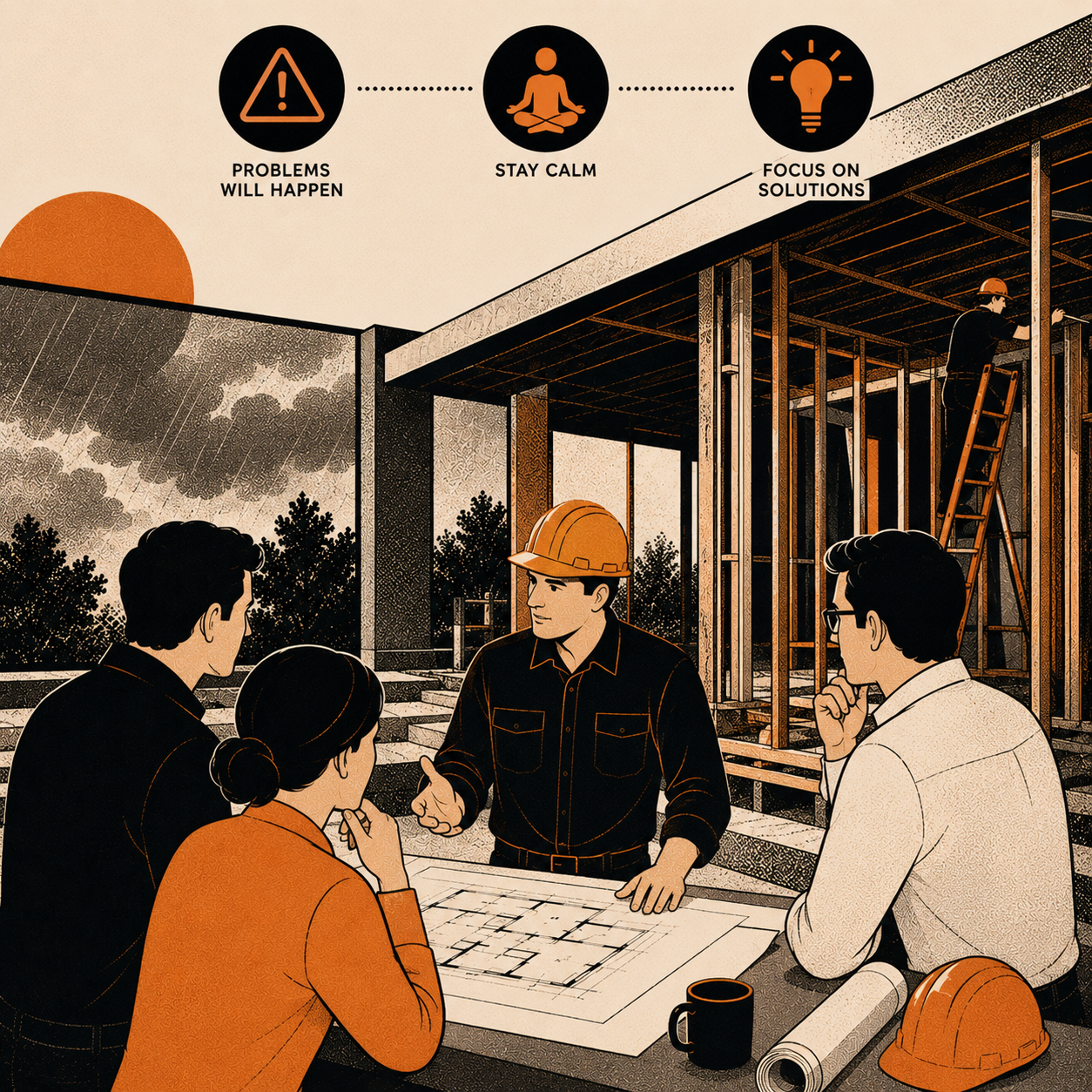
Why Temperament Matters as Much as Skill
Here's what most people don't realize:
Your contractor's technical skill will get you 80% of the way to a successful project.
But it's their temperament—how they handle stress, how they manage crisis, how they communicate under pressure—that determines whether the last 20% is smooth or a disaster.
Anyone who's been through a construction project knows this: things get stressful.
Timelines slip. Costs go up. Problems arise. Decisions have to be made quickly. Tempers flare.
And in those moments, you need a contractor who can keep their cool.
Someone who doesn't panic. Someone who doesn't point fingers. Someone who doesn't transfer their stress onto you, the architect, or the rest of the team.
Someone who can manage the crisis calmly, think clearly, and focus on finding solutions.
Because when problems arise—and they will—the way your contractor handles them will define the entire experience.
What "Staying Calm" Actually Looks Like
Let me give you an example.
Let's say we're in the middle of construction. The framing crew opens up a wall and discovers that a major structural beam is rotted and needs to be replaced.
This is a problem. It's going to cost money. It's going to delay the schedule. And it's going to require a structural engineer to figure out the fix.
Here's how a good contractor handles it:
They call me (the architect) and the client. They explain the problem clearly and calmly. They say, "Here's what we found. Here's why it's an issue. I've already reached out to the structural engineer to get them on site this week. In the meantime, I'm going to pause work in this area so we don't waste time or money on something we might have to redo. Let's regroup once we have the engineer's assessment, and we'll figure out the path forward together."
That's calm. That's professional. That's solution-focused.
Now here's how a bad contractor handles it:
They call in a panic. "We've got a huge problem. The beam is rotted. I don't know what we're going to do. This is going to blow the budget. This is going to delay everything. I don't even know if we can fix this. Why wasn't this caught earlier? This is a disaster."
Now everyone is panicking. The client is freaking out. I'm trying to calm everyone down while also figuring out the solution. And the contractor is adding stress instead of managing it.
See the difference?
Why Panic Doesn't Help
When a problem arises on a construction site, panic doesn't solve anything.
In fact, it makes everything worse.
Panic clouds judgment. It leads to bad decisions. It creates conflict. And it spreads like wildfire—once one person panics, everyone else starts to panic too.
The contractor is the leader on site. Their crew, their subs, the architect, the client—everyone is looking to them to set the tone.
If the contractor stays calm, everyone else stays calm. The problem gets solved methodically and efficiently.
If the contractor panics, the whole project spirals into chaos.
No Finger-Pointing
Here's another thing that happens when contractors can't stay calm:
They start pointing fingers.
"This isn't my fault. The architect should have caught this. The engineer messed up. The previous contractor did shoddy work."
Maybe all of that is true. Maybe it's not. But in the moment, it doesn't matter.
Assigning blame doesn't solve the problem. It just wastes time and creates conflict.
A good contractor focuses on solutions, not blame.
They say, "Here's the problem. Here's how we're going to fix it. Let's move forward."
Finger-pointing can happen later—if it needs to happen at all. But in the moment, the only thing that matters is solving the problem.
This Applies to Everyone
I want to be clear: this quality isn't just important for the contractor.
It's important for everyone on the project.
The architect needs to stay calm. The client needs to stay calm. The engineer, the subs, everyone.
A successful project is built on teamwork. And teamwork falls apart when people start panicking, pointing fingers, or losing their composure.
But the contractor is the one who's on site every day. They're the one managing the crew, coordinating the subs, and dealing with problems as they arise.
So their ability to stay calm under pressure is absolutely critical.
How to Spot It
So how do you know if a contractor can stay calm when things go wrong?
You can't always tell during the interview process. People are on their best behavior when they're trying to win a job.
But here are a few ways to get a sense of it:
1. Ask Them Directly
Ask: "Tell me about a time when something went wrong on a project. How did you handle it?"
Listen to how they tell the story. Do they blame other people? Do they get defensive? Or do they calmly explain the problem and the solution?
2. Talk to Past Clients
This is where references are invaluable.
Ask past clients: "Did anything go wrong during the project? How did the contractor handle it?"
If the client says, "Yeah, we had some issues, but the contractor was great—they stayed calm, communicated clearly, and worked with us to solve it," that's a great sign.
If the client says, "Oh my god, it was a nightmare. The contractor freaked out and started blaming everyone," run.
3. Watch How They Handle the Bidding Process
Even during the bidding process, you can get a sense of someone's temperament.
Do they get defensive when you ask questions? Do they get frustrated when the architect points out something they missed? Do they handle feedback gracefully, or do they push back aggressively?
How they handle small stresses during bidding is a preview of how they'll handle big stresses during construction.
Skill Without Temperament Doesn't Work
Here's the thing:
You could have the most skilled contractor in the world. Someone who knows every technique, every detail, every trick in the book.
But if they can't stay calm under pressure? If they panic when problems arise?
That skill doesn't matter. Because when things get hard—and they will—they're going to fall apart.
I'd rather work with a contractor who's 80% as skilled but has the temperament to handle stress calmly than a contractor who's 100% skilled but loses their mind when problems arise.
Because the reality is, problems are inevitable. And how you handle them is what determines the success of the project.
The Bottom Line
Something will go wrong on your project. That's a guarantee.
And when it does, you need a contractor who can stay calm, think clearly, and focus on solutions.
No panic. No finger-pointing. No transferring stress to everyone else.
Just steady, professional, solution-focused leadership.
That's the kind of contractor you want on your team.
So ask the questions. Talk to the references. And make sure the person you hire has the temperament to handle the hard moments.
Because skill gets you 80% of the way there.
But temperament is what gets you through the finish line.