We've talked about why your contractor needs to be willing to innovate, why they need to be trustworthy, and why they need to have the right expertise for your project type.
Those qualities are critical. They're the foundation.
But there are three more qualities that are just as important—maybe even more so.
Because here's the reality: technical skill gets you 80% of the way to a successful project. But it's these three qualities that determine whether the last 20% is smooth or a complete disaster.
Those qualities are:
The ability to stay calm under pressure
Genuine respect for the design process
Exceptional organization
Let me explain why each of these matters so much, and how to verify your contractor actually has them.
Quality #1: Can You Stay Calm When Things Go Wrong?
Let me give you a guarantee about your construction project:
Something will go wrong.
I don't know what it's going to be. Maybe it'll be small—a material delay, a subcontractor no-show, a minor mistake that needs fixing.
Maybe it'll be big like structural issues discovered during demo, a design detail that doesn't work in the field, weather delays that push the schedule back by months.
But something (probably multiple somethings) will go wrong.
That's just the nature of construction. Especially remodels, where you're working with existing structures and unknowns behind every wall.
And when that happens, the single most important quality your contractor can have is this:
The ability to stay calm.
Why Temperament Matters as Much as Skill
Here's what most people don't realize:
Your contractor's technical skill will get you 80% of the way to a successful project.
But it's their temperament—how they handle stress, how they manage crisis, how they communicate under pressure—that determines whether the last 20% is smooth or a disaster.
Anyone who's been through a construction project knows this: things get stressful.
Timelines slip. Costs go up. Problems arise. Decisions have to be made quickly. Tempers can flare.
And in those moments, you need a contractor who can keep their cool.
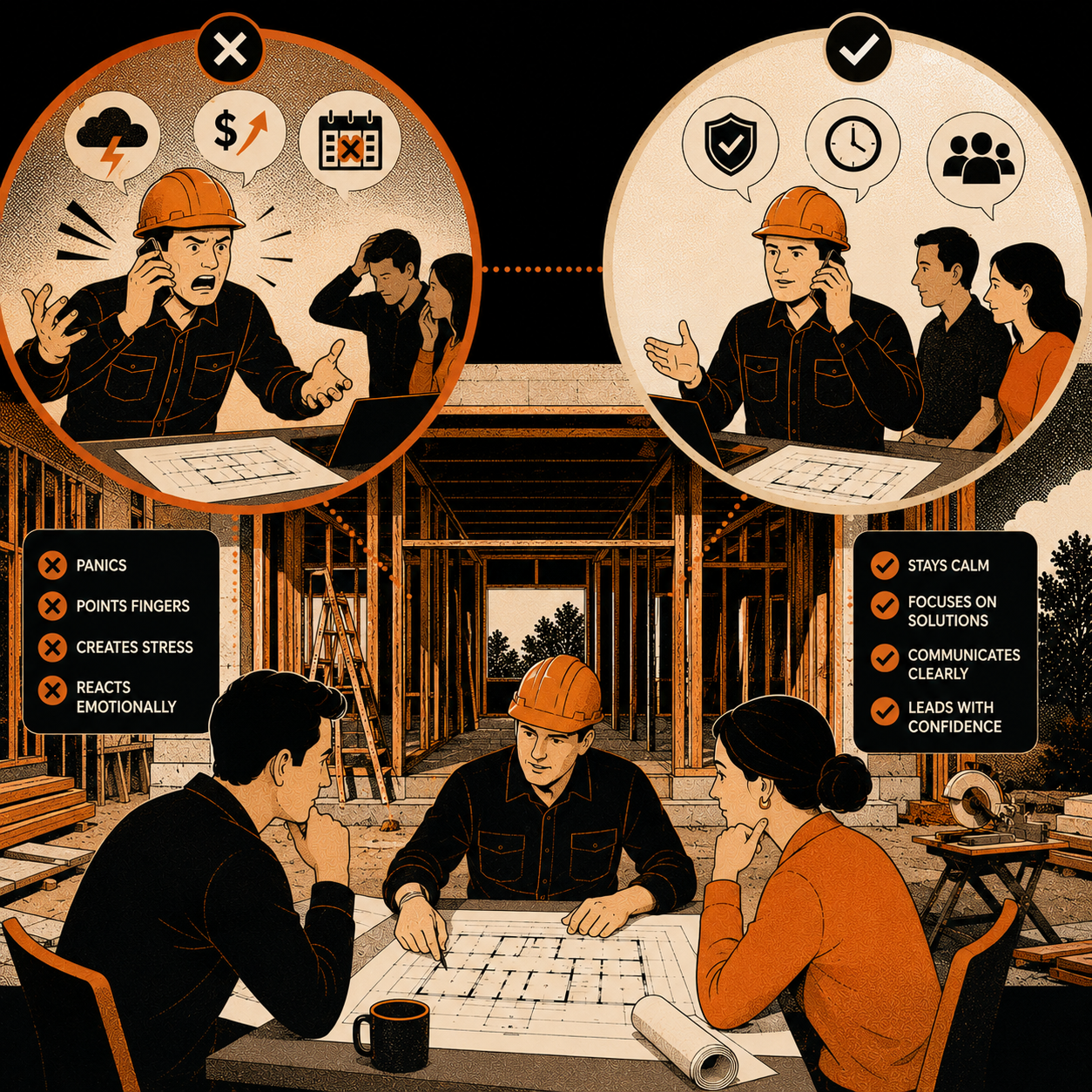
Someone who doesn't panic. Someone who doesn't point fingers. Someone who doesn't transfer their stress onto you, the architect, or the rest of the team.
Someone who can manage the crisis calmly, think clearly, and focus on finding solutions.
What "Staying Calm" Actually Looks Like
Let me give you an example.
Let's say we're in the middle of construction. The framing crew opens up a wall and discovers that a major structural beam is rotted and needs to be replaced.
This is a problem. It's going to cost money. It's going to delay the schedule. And it's going to require a structural engineer to figure out the fix.
Here's how a good contractor handles it:
They call me (the architect) and the client. They explain the problem clearly and calmly. They say, "Here's what we found. Here's why it's an issue. I've already reached out to the structural engineer to get them on site this week. In the meantime, I'm going to pause work in this area so we don't waste time or money on something we might have to redo. Let's regroup once we have the engineer's assessment, and we'll figure out the path forward together."
That's calm. That's professional. That's solution-focused.
Now here's how a bad contractor handles it:
They call in a panic. "We've got a huge problem. The beam is rotted. I don't know what we're going to do. This is going to blow the budget. This is going to delay everything. I don't even know if we can fix this. Why wasn't this caught earlier? This is a disaster."
Now everyone is panicking. The client is freaking out. I'm trying to calm everyone down while also figuring out the solution. And the contractor is adding stress instead of managing it.
See the difference?
Why Panic Doesn't Help
When a problem arises on a construction site, panic doesn't solve anything.
In fact, it makes everything worse.
Panic clouds judgment. It leads to bad decisions. It creates conflict. And it spreads like wildfire. Once one person panics, everyone else starts to panic too.
The contractor is the leader on site. Their crew, their subs, the architect, the client…everyone is looking to them to set the tone.
If the contractor stays calm, everyone else stays calm. The problem gets solved methodically and efficiently.
If the contractor panics, the whole project spirals into chaos.
No Finger-Pointing
Here's another thing that happens when contractors can't stay calm:
They start pointing fingers.
"This isn't my fault. The architect should have caught this. The engineer messed up. The previous contractor did shoddy work."
Maybe all of that is true. Maybe it's not. But in the moment, it doesn't matter.
Assigning blame doesn't solve the problem. It just wastes time and creates conflict.
A good contractor focuses on solutions, not blame.
They say, "Here's the problem. Here's how we're going to fix it. Let's move forward."
Finger-pointing can happen later—if it needs to happen at all. But in the moment, the only thing that matters is solving the problem.
This Applies to Everyone
I want to be clear: this quality isn't just important for the contractor.
It's important for everyone on the project.
The architect needs to stay calm. The client needs to stay calm. The engineer, the subs, everyone.
A successful project is built on teamwork. And teamwork falls apart when people start panicking, pointing fingers, or losing their composure.
But the contractor is the one who's on site every day. They're the one managing the crew, coordinating the subs, and dealing with problems as they arise.
So their ability to stay calm under pressure is absolutely critical.
How to Spot It
So how do you know if a contractor can stay calm when things go wrong?
You can't always tell during the interview process. People are on their best behavior when they're trying to win a job.
But here are a few ways to get a sense of it:
Ask them directly: "Tell me about a time when something went wrong on a project. How did you handle it?"
Listen to how they tell the story. Do they blame other people? Do they get defensive? Or do they calmly explain the problem and the solution?
Talk to past clients: Ask: "Did anything go wrong during the project? How did the contractor handle it?"
If the client says, "Yeah, we had some issues, but the contractor was great—they stayed calm, communicated clearly, and worked with us to solve it," that's a great sign.
If the client says, "Oh my god, it was a nightmare. The contractor freaked out and started blaming everyone," run.
Watch how they handle the bidding process: Even during bidding, you can get a sense of someone's temperament.
Do they get defensive when you ask questions? Do they get frustrated when the architect points out something they missed? Do they handle feedback gracefully, or do they push back aggressively?
How they handle small stresses during bidding is a preview of how they'll handle big stresses during construction.
Quality #2: Do You Value Design?
Now let me be clear about something upfront:
A contractor who values design is not the same as a contractor who thinks they're a designer.
Those are two very different things. And understanding the difference is critical.
A contractor who values design respects the design process. They understand its importance. They're invested in bringing the vision to life with excellence. They care about the final product just as much as you and the architect do.
A contractor who thinks they're a designer? That's a problem. Because they start making design decisions that aren't theirs to make. And that leads to conflict, confusion, and compromised outcomes.
What "Valuing Design" Actually Means
When I say a contractor needs to value design, here's what I mean:
They understand that good design matters. They believe that creating a beautiful, well-executed, thoughtfully designed home is worth the effort. And they're committed to making that happen.
They're not just building a box. They're not just executing a floor plan. They're bringing a vision to life.
And that vision—the one you and the architect have spent months developing—is sacred to them. They're going to do everything in their power to execute it correctly.
That means:
They respect the architect's role. They don't try to override design decisions or make changes without consulting the architect first.
They're invested in quality. They care about getting the details right, even when it's harder or more time-consuming.
They communicate proactively. When they see a potential problem or conflict, they bring it up early so it can be solved collaboratively.
They're proud of the final product. They want to build something they can put in their portfolio and show off.
Why This Matters
When a contractor values design, a lot of other things fall into place naturally.
Communication improves. Because the contractor understands that they're part of a team working toward a shared vision, they communicate openly with the architect. They ask questions. They flag potential issues. They collaborate instead of dictating.
Quality goes up. Because they care about the final product, they're not going to cut corners or compromise quality to save time or money. They're going to do it right.
Trust is built. When you know your contractor is as invested in the vision as you are, you can relax a little. You don't have to micromanage. You don't have to worry that they're going to make decisions that undermine the design.
On the flip side, when a contractor doesn't value design, everything gets harder.
They start taking shortcuts. They start changing things without asking. They push back on details that seem "unnecessary" to them. And the friction between the contractor and the architect (and between the contractor and you) starts to build.
The Red Flag: Contractors Who Spew Design Ideas
Here's a major red flag to watch for:
You're walking a contractor through your house (or the site). You're showing them what you're thinking about doing. And before you even finish explaining, they start spewing design ideas.
"Oh, you should do this. You should knock down that wall. You should add a window here. You should change the layout to this."
Run.
That contractor doesn't value design. They think they're the designer. And that's a disaster waiting to happen.
A contractor who values design will listen. They'll ask questions. And then they'll say something like this:
"Interesting. Have you talked to an architect yet? Because I think a good designer could really help you figure out the best approach here."
That's the response you want.
Because it shows they understand their role. They know they're the builder, not the designer. And they respect the design process enough to encourage you to work with a professional.
Mutual Respect
This isn't about drawing a hard line and saying, "Architects design, contractors build, and never the two shall meet."
That's not how good projects work.
Good projects are collaborative. The architect and the contractor work together. They solve problems together. They respect each other's expertise and lean on each other when needed.
I only want to work with contractors who know their profession really well. When there's a technical issue or a construction challenge, I'm going to ask them: "What do you recommend? How do we solve this?"
And I want them to do the same with me. When there's a design question or a spatial issue, I want them to say, "I don't know the answer to that. Let's ask the architect."
That's mutual respect. And it's the foundation of a successful working relationship.
The Contractor-Architect Relationship
Here's something else most clients don't think about:
You need to like your contractor. But your architect needs to be able to work with them.
And there's a big difference.
You're going to interact with your contractor periodically throughout the project. You'll be involved in big decisions. You'll visit the site. You'll approve selections. But most of the day-to-day work? That's happening between the contractor and the architect.
They're the ones solving problems together. Making technical decisions together. Coordinating the work. Managing the schedule. Navigating the inevitable challenges that arise during construction.
After the client-architect relationship, the contractor-architect relationship is the most important dynamic on the project.
So yes, you need some rapport with your contractor. But your architect needs to be able to work with them effectively. Because if they can't, the project is going to suffer.
Here's my advice:
Hire your architect first. Then ask them for contractor recommendations. Your architect has worked with a lot of contractors. They know who's good. They know who's reliable. They know who they work well with.
Involve your architect in the interview process. When you're interviewing contractors, have your architect present. Let them ask questions. Let them get a sense of how the contractor communicates and whether they're going to be collaborative or combative.
Pay attention to your architect's reaction. After the interview, ask your architect: "What did you think?"
If your architect says, "I think they'd be great to work with," that's a green light.
If your architect says, "I'm not sure about them. I'm worried about X, Y, Z," listen to that. Your architect's instincts are based on years of experience working with contractors.
Quality #3: Are You Organized?
Here's the final quality your contractor absolutely must have:
They need to be organized.
Not just "pretty organized." Not "organized enough."
Very, very, very organized.
And I know that might sound basic. But let me tell you: a shocking number of contractors—even ones with decent portfolios—are disorganized. And that disorganization will cost you time, money, and sanity.
Why Organization Matters
Let me give you some context.
A custom home or major remodel is going to take 18 months to 3 years to complete.
During that time, dozens—maybe hundreds—of different people are going to touch the project. General contractor, architect, structural engineer, MEP engineers, framers, electricians, plumbers, HVAC techs, drywallers, painters, tile installers, cabinet makers, landscape contractors, and on and on.
Every one of those people needs to be coordinated. Scheduled. Managed.
There are thousands of decisions to make. Hundreds of materials to order. Submittals to review. Shop drawings to approve. Change orders to track. Budget updates to manage.
And all of that needs to happen in the right order, at the right time, with clear communication.
If your contractor is disorganized, that doesn't happen.
Decisions don't get made. Materials don't get ordered on time. The schedule slips. The budget balloons. And you're left wondering what the hell is going on.
What Disorganization Looks Like
Let me paint a picture.
The contractor doesn't have a clear schedule. You ask when the electrician is coming, and they say, "Probably next week? I'll let you know."
Materials get ordered late or not at all. The tile you selected three months ago? It's on backorder because no one placed the order in time. Now you're delayed by six weeks.
Communication is sporadic. You send an email asking a question, and it takes three days to get a response. Or you don't get a response at all.
The budget is a mess. You ask for an updated budget, and the contractor can't give you one. They say, "We're probably around here, but I'm not sure."
Mistakes happen on site because the crew doesn't have clear direction. The framing is wrong. The window gets installed in the wrong location. And now you have to tear it out and redo it.
That's what disorganization looks like. And it's exhausting.
What Organization Looks Like
Now let me show you the other side.
The contractor has a detailed schedule. You can see exactly when each phase is happening. You know when the electrician is coming. You know when the tile is being installed. You know when inspections are scheduled.
Materials are ordered well in advance. The contractor has a system for tracking lead times. They know what needs to be ordered when. And they make sure everything arrives on time.
Communication is clear and consistent. The contractor sends weekly updates. They respond to emails within 24 hours. They keep you and the architect in the loop on everything.
The budget is transparent. You get monthly budget reports. You know exactly where you stand. There are no surprises.
The crew has clear direction. The contractor holds regular meetings with the subs. Everyone knows what's expected. Mistakes are rare because everyone is on the same page.
That's what organization looks like. And it makes all the difference.
You Can't Wing a Multi-Year Project
Here's the thing:
Some clients think, "Oh, we'll just figure it out as we go. We'll see what happens."
No.
That mindset is the complete opposite of what you need for a successful project.
You can't wing a two-year construction project. You can't hope things work out. You can't rely on everyone just "figuring it out."
You need systems. You need structure. You need organization.
Because without that, things fall apart.
What to Look For
So how do you know if a contractor is organized?
Here's what to look for:
Systems and software: Ask: "What systems do you use to manage projects?"
Organized contractors use project management software. They have systems for scheduling, budgeting, tracking submittals, managing change orders, and communicating with the team.
If a contractor says, "Oh, I just keep track of everything in my head," run.
Clear processes: Ask: "Can you walk me through your process for managing a project like mine?"
An organized contractor will be able to describe their process clearly—how they create the schedule, manage the budget, coordinate subs, handle change orders, and communicate with the client and architect.
If they can't articulate a clear process, that's a red flag.
Sample documents: Ask: "Can you show me sample project documents?"
Some contractors have sample document lists they share during the interview process—budget spreadsheets, schedules, meeting notes templates, mock-up documentation, submittal tracking sheets.
If they can show you all of that, you know they're serious about organization.
Staffing: Ask: "Who's on your team? What roles do you have?"
Organized contractors have staff in place to manage the work—project managers, assistant project managers, bookkeepers, scheduling coordinators.
If it's just the contractor and no support staff, they're going to be stretched too thin to manage a complex project effectively.
Organization Saves Time and Money
Here's something that surprises clients:
Being organized actually saves time and money in the long run.
Yes, it requires effort upfront. It takes time to set up systems, create schedules, track budgets, document everything.
But that effort pays off.
When you're organized, you catch problems early. You order materials on time. You avoid delays. You minimize mistakes. You keep the project on track.
When you're disorganized, you're constantly putting out fires. You're reacting to problems instead of preventing them. And that wastes time and money.
So even though organized contractors might seem more expensive upfront (because they have the staff and systems in place), they're often more cost-effective in the end.
The Bottom Line
Technical skill matters. Expertise matters. Trustworthiness matters.
But these three qualities, the ability to stay calm under pressure, genuine respect for the design process, and exceptional organization, are just as critical.
Because when things go wrong (and they will), these are the qualities that determine whether your project succeeds or falls apart.
So ask the questions. Talk to the references. Involve your architect. And make sure the contractor you hire has all of these qualities before you sign the contract.
Your project and your sanity depend on it.