Here's a hard truth that most clients don't realize:
A contractor who's amazing at one type of project might be terrible at another.
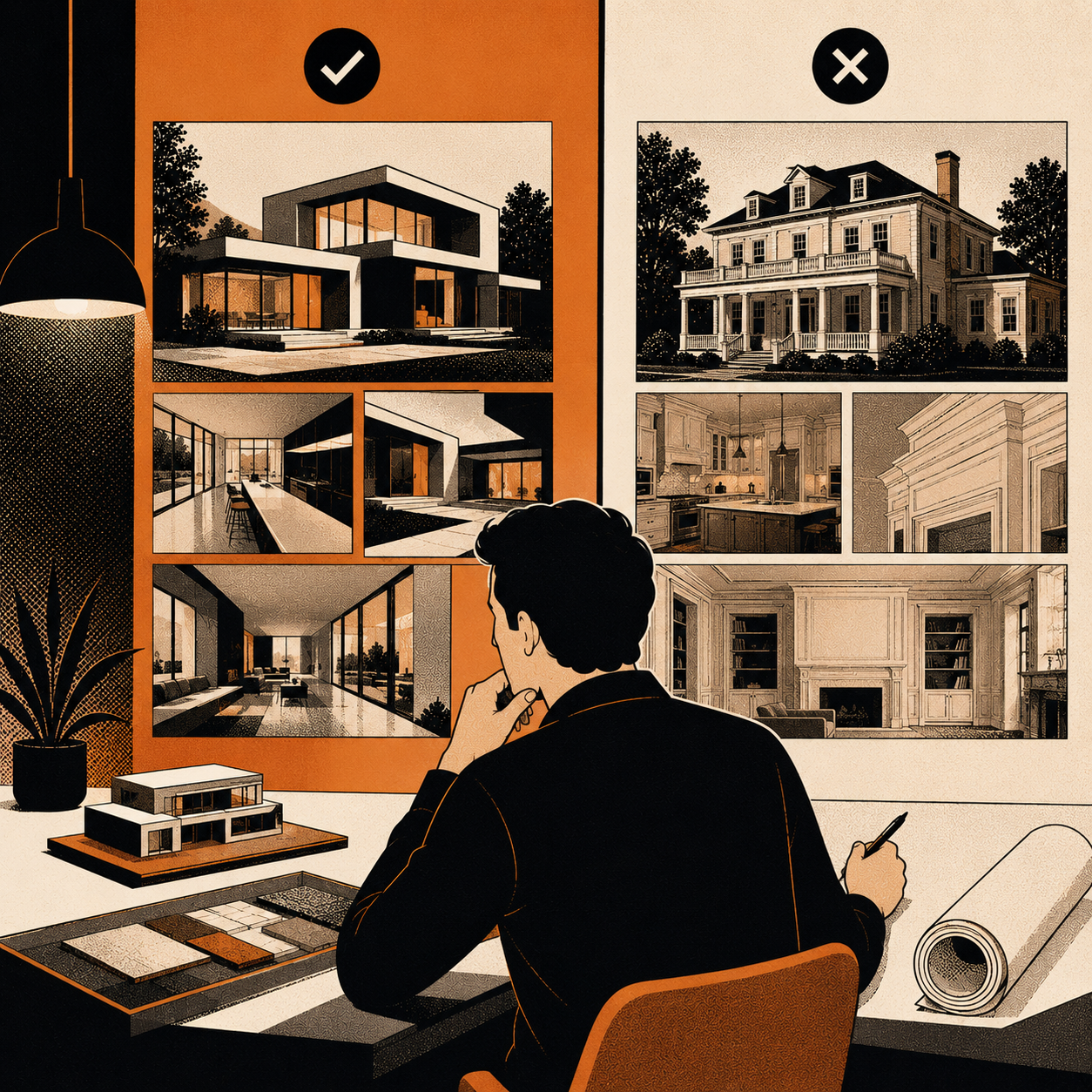
A contractor who builds beautiful traditional homes might struggle with modern design. A contractor who excels at ground-up new construction might be out of their depth on a complex remodel.
Expertise isn't one-size-fits-all. It's project-specific.
And if you hire a contractor whose skills don't match your project type, you're going to end up with compromised quality, missed details, and a final product that doesn't live up to what it could have been.
Here's how to make sure your contractor has the right expertise for what you're actually building.
Why Expertise Is Project-Specific
Let me give you an example.
Let's say you're building a modern home. Clean lines, minimal trim, floor-to-ceiling windows, crisp details.
You interview a contractor who has an incredible portfolio—beautiful traditional homes with gorgeous millwork, intricate trim details, classical proportions. Their work is stunning.
But here's the problem: building a modern home requires completely different skills than building a traditional one.
In a traditional home, you can hide imperfections behind trim, molding, and ornamentation. If a wall isn't perfectly plumb, you add a piece of trim to cover the gap. If a corner isn't quite right, you add a decorative element to disguise it.
In a modern home? There's nowhere to hide.
Every line has to be perfect. Every seam has to be tight. Every surface has to be flawless. Because there's no trim, no ornamentation, no decorative elements to cover mistakes.
That requires a completely different level of precision. And it requires a crew that's been trained to work that way.
So if you hire a contractor who's built 50 traditional homes but only one or two modern homes, they're going to struggle. Their crew isn't going to have the muscle memory. They're not going to know the techniques. And the final product is going to show it.
Modern vs. Traditional: Different Skill Sets
This isn't about one being better than the other. Both are challenging. Both require expertise.
But they require different kinds of expertise.
Building traditional homes requires mastery of millwork, trim carpentry, classical proportions, and architectural detailing. It's about understanding an established architectural language and executing it beautifully.
Building modern homes requires precision framing, flawless drywall, perfect alignment, and the ability to execute details that don't follow a playbook. It's about problem-solving and creating something that hasn't been done before.
Those are different skill sets. And very few contractors are equally good at both.
So here's my advice: look at the contractor's portfolio and make sure they've built projects similar to yours.
If you're building a modern home, you want a contractor whose portfolio is full of modern homes.
If you're building a traditional home, you want a contractor whose portfolio is full of traditional homes.
Don't assume that just because they're good at one, they'll be good at the other.
Remodels vs. Ground-Up: Another Critical Distinction
Here's another distinction that matters: remodels are fundamentally different from ground-up construction.
I've worked with contractors who are amazing at new construction but completely out of their depth on remodels. And vice versa.
Why?
Because remodels are more complex.
With new construction, you're starting from scratch. You control everything. You know exactly what's going into the walls because you're the one building them.
With remodels, you're working with an existing structure. You don't know what's behind the walls until you open them up. You're constantly discovering problems—old wiring that's not up to code, structural issues that need to be fixed, plumbing that's routed in a weird way.
And every time you discover something, you have to adapt. You have to problem-solve on the fly. You have to figure out how to integrate the new work with the old work in a way that's seamless and code-compliant.
That requires a different mindset. A different skill set. A different kind of experience.
So if you're doing a remodel, make sure your contractor has extensive remodel experience. Don't hire someone who mostly does ground-up construction and assume they'll figure it out.
They might. But they also might not. And you don't want to find out the hard way.
How to Verify Expertise
So how do you know if a contractor has the right expertise?
Here's what to look for:
1. Portfolio
Ask to see their portfolio. Not just a few photos—ask for a comprehensive look at what they've built.
Then look for projects that match yours in type and style.
If you're building a 3,000-square-foot modern home, you want to see that they've built modern homes of similar scale.
If you're doing a whole-house remodel, you want to see whole-house remodels.
If they've only done projects that are drastically different from yours, that's a red flag.
2. References Specific to Your Project Type
When you ask for references, ask for references from projects similar to yours.
If you're building a modern home, talk to clients who hired them for modern homes.
If you're doing a remodel, talk to clients who hired them for remodels.
Ask those clients:
Did the contractor understand the unique challenges of this type of project?
Did they have the right team and subcontractors for this kind of work?
How did the quality compare to what you expected?
3. Team and Subcontractors
A contractor's expertise isn't just about them as an individual. It's about their team and their subcontractors.
A contractor who specializes in modern homes has a crew that's been trained to work with the precision modern design requires.
A contractor who specializes in remodels has subcontractors who are comfortable working in tight spaces, dealing with unknowns, and adapting on the fly.
Ask your contractor:
Who's on your team?
Who are your key subcontractors?
How long have you been working with them?
Have they worked on projects like mine before?
A contractor with a stable, experienced team is much more likely to deliver quality work than a contractor who's constantly rotating through different subs.
The Hairdresser Analogy
Here's an analogy I like:
If you have very straight, thin hair, you could go to a hairdresser who specializes in curly hair. They might do a decent job.
But the chances of it being the best haircut of your life? Pretty low.
If you want the best haircut of your life, you go to someone who specializes in straight, thin hair. Someone who's done it a thousand times. Someone who knows exactly how to cut it to make it look great.
The same is true for contractors.
You could hire a contractor who's done one or two projects like yours but mostly does something else.
But if you want the best result possible, you hire the contractor who specializes in exactly what you're doing.
Don't Gamble
I get it. Sometimes you find a contractor you really like. They're trustworthy, they're organized, they're easy to work with.
But their portfolio doesn't quite match your project.
And you think, "Well, they seem great. I'm sure they'll figure it out."
Maybe they will. But maybe they won't.
And the stakes are too high to gamble.
You're investing hundreds of thousands—maybe millions—of dollars. You're investing years of your life. You're building something that's supposed to last for decades.
Why would you take that risk?
Go with the contractor who has proven expertise in the exact type of project you're doing.
It might cost a little more. But the quality and the peace of mind are worth it.
The Bottom Line
Expertise isn't universal. It's project-specific.
A great contractor for traditional homes might be terrible for modern ones.
A great contractor for ground-up construction might struggle with remodels.
So before you hire someone, make sure they have extensive experience with projects like yours.
Look at their portfolio. Talk to references. Ask about their team and their subs.
And don't gamble. Go with proven expertise.
Your project deserves it.