When I design a remodel, I don't just hand you one plan and say, "Here's what we're doing."
That's not how good design works.
Instead, I show you multiple options—different scopes, different levels of intervention—so you can see what's possible at different price points and make an informed decision about what matters most to you.
Because here's the thing: there's never just one way to solve a design problem. There are always multiple paths. And part of my job is to show you those paths so you can choose the one that aligns with your priorities and your budget.
Here's how the design process actually works, and why constraints often lead to the most creative solutions.
Showing You Multiple Options
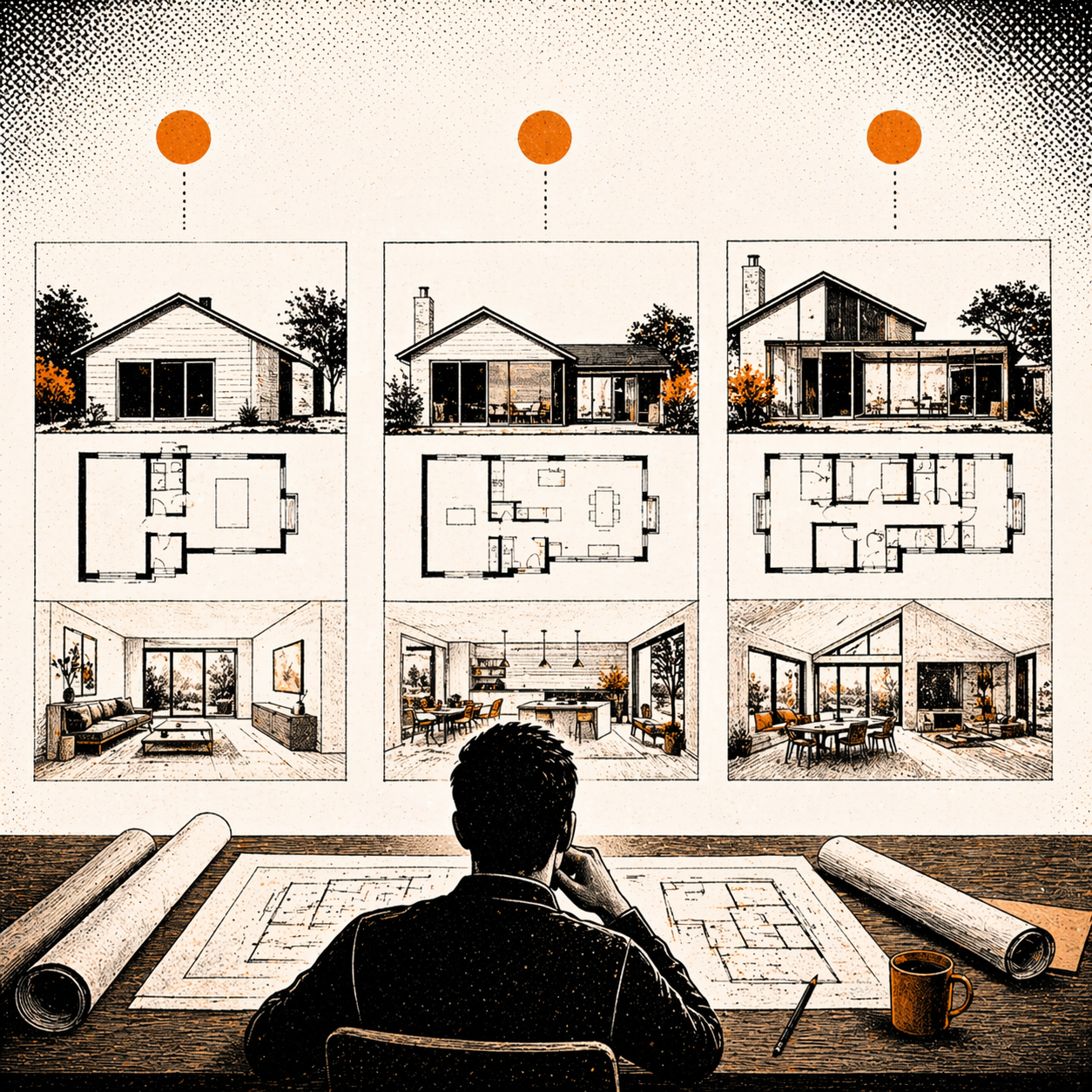
At the first design presentation—after I've done all the discovery work, analyzed your house, and started sketching—I'll typically present three different concept options.
Each option represents a different scope of work, but all three execute the same vision we've talked about and established together.
Option 1: This is what we can do with the least amount of construction to get you where you want to be. It's the most conservative approach. Minimal demolition, minimal structural work, maximum efficiency.
Option 2: This is a moderate scope. A bit more work than Option 1, but still restrained. Maybe we're opening up one wall, reworking one major space, making a few targeted interventions.
Option 3: This is the most amount of work—potentially even a little beyond your stated budget, just to show you what's possible if you stretched.
Why do I do this?
Because it's the first time you're seeing your ideas put down on paper in different ways. And seeing those options side by side helps you understand the trade-offs.
Sometimes you'll look at Option 3 and say, "Yeah, we have to do that. The gains are totally worth it."
Other times you'll look at Option 1 and say, "You know what? This smaller scope actually gets us 90% of the way there. Let's do this and save the money."
The point is: you get to choose based on what matters most to you.
Clarifying Priorities
This process also helps clarify your priorities in a way that conversation alone can't.
A lot of times, clients come to me thinking one thing is at the top of their list—new bathroom finishes, an extra sink, updated tile—but after seeing the options, they realize the real problem is something else entirely.
Maybe the bathroom finishes aren't the issue. Maybe the issue is that the whole floor plan is wrong. Maybe the bathroom has no windows and feels like a dark box every time you step into it.
Seeing the options on paper helps you realize: Oh. You're right. The floor plan is the problem. Let's fix that instead of just putting lipstick on a pig.
That's the power of showing multiple approaches. It's a communication tool that clarifies scope, expectations, priorities, and vision all at once.
Designing with Contingencies
Here's something most clients don't think about: when I'm designing a remodel, I'm also designing with contingencies.
What does that mean?
It means I'm anticipating that once we start construction and open up walls, we're going to find things that require the design to shift slightly.
I don't know what we're going to find. But I know we're going to find something.
So I design in a way that doesn't rely too heavily on elements that are likely to change. If there's a wall I'm not 100% certain about, I'm not making it a key feature of the design.
Or, if it is a key feature, I'm planning for it early. I'm talking to the structural engineer or the contractor during the design phase and saying, "We think there's a 50% chance we're going to have to do X. Let's plan for it now so we're not caught off guard later."
I'm building flexibility into the design so that when surprises show up—and they will—we can adapt without the whole project falling apart.
Being Efficient (Not Wasteful)
One of my core principles when designing remodels is this: be as efficient as possible.
The easy route would be to ignore all the challenges of the existing structure, demolish everything, and basically build new. Keep the foundation and maybe the roof framing, but gut everything else.
But that's wasteful. And expensive.
Remodels can get very costly very quickly, especially once you start taking down structural elements. So if there are ways to be mindful of the existing bones of the home—to make very specific, strategic moves that transform how the space feels without blowing it up completely—that's the approach I take.
You don't need to demolish everything to make a space feel completely different.
Sometimes a very small intervention—opening one wall, adding one window, rethinking one spatial relationship—can have a massive impact.
Why Efficiency Matters
This desire to be efficient and surgical (rather than reckless) comes from a few places.
First, it's respectful of your budget. Even if you have a lot of money, I still don't want to waste it. I want every dollar to go toward something that meaningfully improves your home.
Second, it's respectful of materials. Construction is an incredibly wasteful industry. Massive amounts of material get thrown away on every project. As a profession, we need to be more thoughtful about that. If I can preserve something that's already there and make it work, I will.
Third, it's smarter design. Working within constraints forces me to think harder, be more creative, and come up with solutions that I wouldn't have thought of if I had carte blanche.
Constraints Breed Creativity
Here's something that might surprise you: the best design solutions often come from working with constraints, not against them.
When I'm designing a new house from scratch, I have total freedom. Blank slate. I can do whatever I want.
But when I'm working on a remodel, I have constraints. Existing walls. Existing structure. Budget limitations. Spatial limitations.
And those constraints force me to think differently.
I can't just default to the obvious solution. I have to get creative. I have to find a way to solve the problem within the boundaries I've been given.
And more often than not, that leads to something really interesting—something I wouldn't have come up with if I'd had unlimited freedom.
The Takeaway
Good remodel design isn't about doing more. It's about doing the right things.
It's about showing you multiple options so you can make informed decisions.
It's about being efficient and strategic instead of wasteful.
And it's about embracing constraints—because often, those constraints lead to the most creative, most personal, most interesting solutions.
Your house has limitations. That's a given. But those limitations don't have to hold you back.
Sometimes, they're exactly what lead to the breakthrough.