If you think remodel construction is just about executing the plan and checking boxes, you're going to be blindsided.
Remodel construction is messy. It's unpredictable. And it requires constant adaptation.
Walls get opened. Surprises get discovered. Conditions change. And decisions have to be made quickly—sometimes on the spot—to keep the project moving.
Your architect can't just disappear after handing off the drawings. They need to be there. They need to be responsive. They need to be ready to problem-solve throughout the entire process.
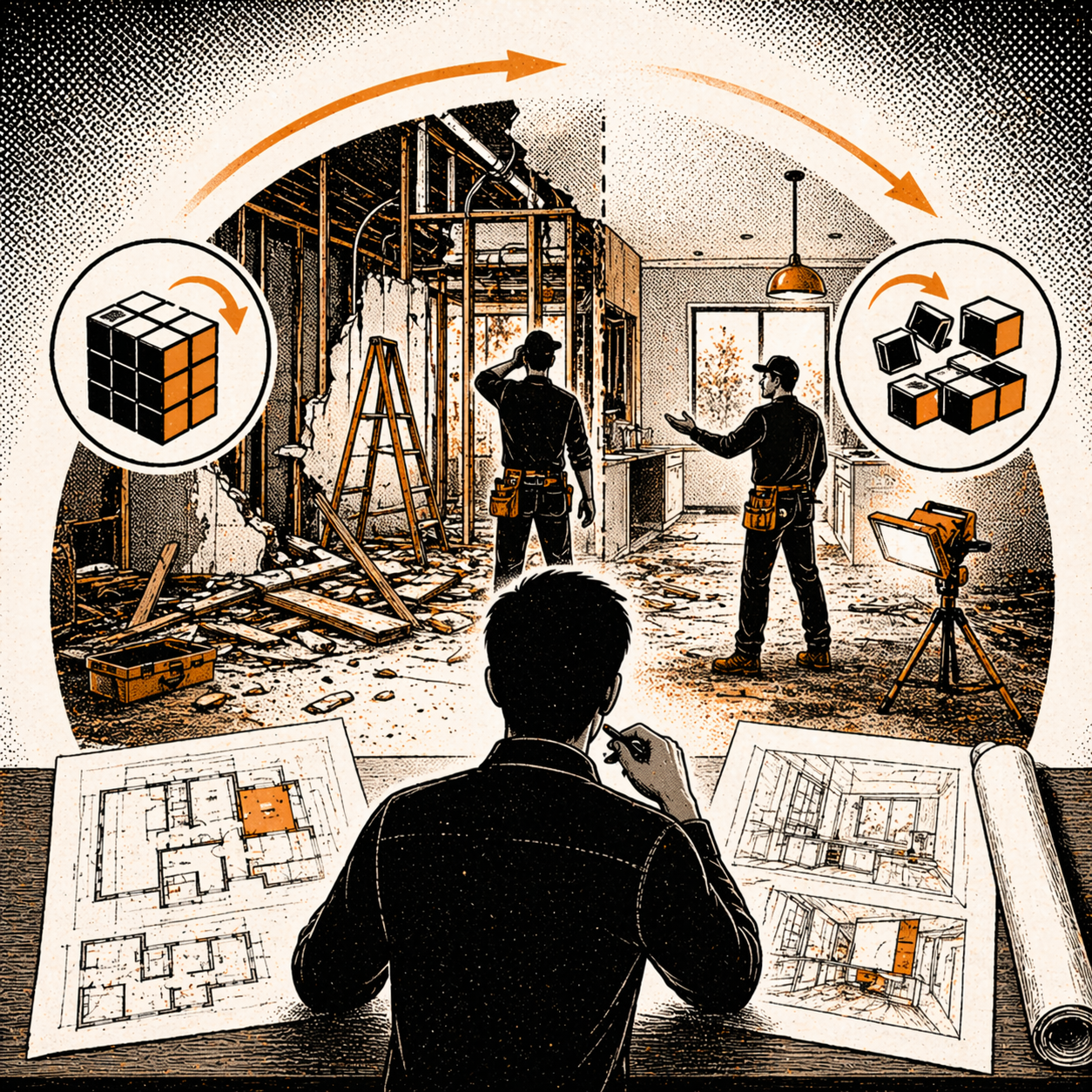
Here's what construction actually looks like during a remodel, and why you need an architect who not only understands this but thrives in it.
Here's how I describe the difference between new construction and remodels:
New construction is like solving a Rubik's Cube. You look at it, you figure out your path, and then you execute. The puzzle doesn't change while you're solving it.
Remodels are like solving a Rubik's Cube that changes while you're solving it. You start working on it, you make progress, and then suddenly the cube shifts. Now you have to adapt and solve it again with the new configuration.
That's what remodel construction feels like. You can plan all you want, but once you start opening walls, things change. And you have to be ready to adjust.
Why Responsiveness Matters
When construction is happening, things move fast.
The contractor's crew is on site. They've opened a wall. They've found a condition—maybe a drainage pipe running where we wanted to put a medicine cabinet, or a structural issue that requires a different approach.
The project stalls until a solution is found.
If I'm not responsive—if I don't pick up the phone, if I take three days to get back to them—the entire project grinds to a halt. The crew is standing around. The schedule gets delayed. Costs start to climb.
But if I'm available, if I can get on a call quickly, walk through the issue, brainstorm solutions with the contractor, and make a decision that day—we keep moving.
That's what being responsive means. It's not just answering emails. It's being actively engaged in the project, ready to adapt and solve problems in real time.
Why You Need an Architect Who Specializes in Remodels
Not all architects are built for this kind of work.
Most architects live in the conceptual space. We ideate. We draw. We create documentation. We plan, plan, plan for months. And then it gets built.
That's the rhythm of new construction. Heavy planning upfront, then execution.
But remodels don't work that way. Remodels require you to keep designing during construction. You have to be comfortable with uncertainty. You have to be okay with changing the plan mid-stream. You have to enjoy that kind of work.
If you hire an architect who only does new construction, they're not going to be prepared for this. They're going to get frustrated when things change. They're going to resist adapting. They're going to want to stick to the plan even when the plan doesn't make sense anymore.
You need someone who expects this. Someone who thrives on problem-solving under pressure. Someone who sees construction as a continuation of the design process, not just an execution phase.
That's the kind of architect you want on a remodel.
Breaking Bad News (With Solutions)
One of the skills that matters most during remodel construction is knowing how to communicate bad news.
Because there will be bad news. Things will go wrong. Surprises will be expensive. Decisions will be tough.
And when that happens, the last thing you want is for me to call you in a panic and say, "We have a huge problem and I don't know what to do."
That's not helpful. That just stresses you out.
Instead, here's how I handle it:
When a problem comes up, I don't immediately go to the client. I talk to the contractor first. I talk to the engineer if needed. I brainstorm solutions. I figure out what our options are.
Then I go to the client and say, "Here's what we found. Here's why it's an issue. And here's three ways we can solve it. Option A does this, Option B does that, Option C is the most expensive but gives us the best outcome. What do you think?"
Now the client isn't just hearing problems. They're hearing problems with solutions. And they can make an informed decision without panicking.
That's the difference between an architect who's good at this and one who isn't.
You're Not Going to See Everything
Here's something clients need to understand: I can't catch every single mistake.
I'm on site regularly—depending on the phase. I'm looking at the work. I'm checking progress. I'm making sure things align with the drawings.
But I'm not there every day. I'm not supervising every single task. That's not my role.
The contractor and their subs are professionals. I have to trust that they're doing their jobs correctly.
My job is oversight, not supervision. I'm there to catch the big things, to provide clarity when there's confusion, and to solve problems when they arise.
And honestly? Most of the time, things go smoothly. But when they don't, that's when having an experienced architect who knows how to handle it makes all the difference.
Why Good Contractors Want Architects on the Job
Here's something that might surprise you: good contractors don't want to do remodels without an architect providing construction administration.
They don't want to be making design decisions. They don't want to be fielding questions from the client about aesthetics and spatial layout. They don't want to be the ones figuring out how to solve a structural problem that has design implications.
They want to build. That's their expertise. That's what they're good at.
So when I'm on the job, they're relieved. They have someone to collaborate with. They have someone who understands both the technical side and the design side. They have someone who can make decisions quickly so they can keep working.
It's a partnership. And the best projects happen when that partnership is strong.
It's Not Always Pretty
I'm not going to lie to you: remodel construction can be frustrating.
You spend months designing something you love. You refine it. You get it perfect. And then you get to construction and—surprise—you have to change it.
That can be hard. Especially for someone like me, who cares deeply about the design.
But that's the reality of working with existing structures. You can't control everything. You have to be flexible.
And honestly? Some of the best solutions I've ever come up with have happened during construction, when I was forced to adapt.
So yeah, it's not always pretty. But it's also where some of the most creative work happens.
The Bottom Line
Remodel construction is not a passive phase. It's not about handing off the drawings and hoping for the best.
It's active. It's collaborative. It's adaptive. And it requires an architect who's ready to be in the trenches with you, solving problems and making decisions in real time.
If you hire an architect who disappears after the drawings are done, your project is going to suffer.
But if you hire someone who's responsive, who's experienced with remodels, and who's ready to problem-solve throughout the entire process?
You're going to get a transformation that actually works.