When you're interviewing contractors, most people ask about price, timeline, and references. They want to know: Have you done projects like mine before? What's your availability? Can you work within my budget?
Those are all valid questions. But there's one question that matters more than any of them—especially if you're building a custom home or doing a remodel that's meant to be unique, personal, and different from everything else out there.
That question is: Are you willing to innovate?
And I know that sounds vague. So let me explain exactly what I mean—and why it's the single most important quality to look for in a contractor.
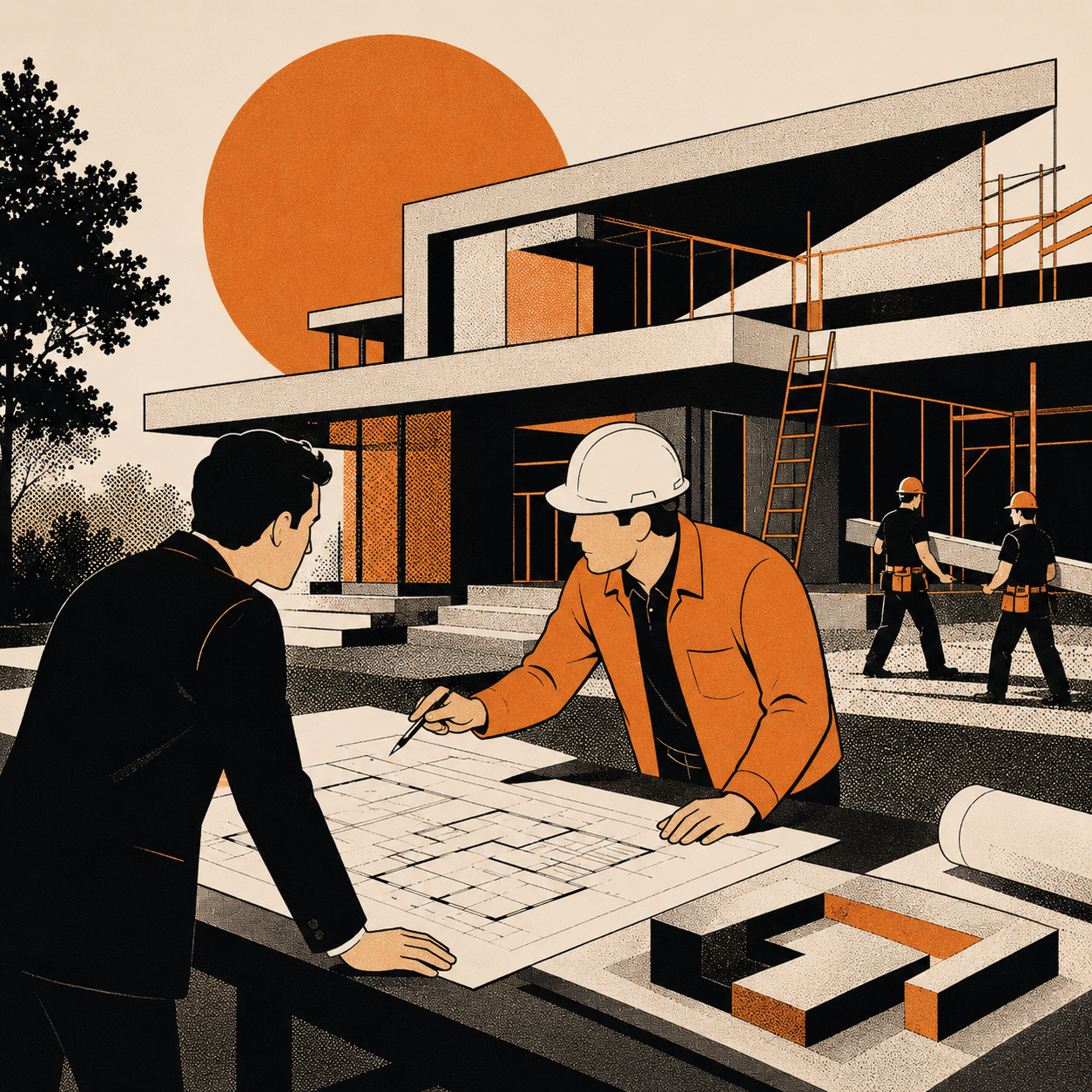
What "Willing to Innovate" Actually Means
When I say a contractor needs to be willing to innovate, I don't mean they need to be inventing new construction methods or reinventing the wheel.
I mean they need to be comfortable building things they haven't built exactly that way before.
Because here's the reality: if you're doing a custom home—something designed specifically for you, tailored to your life, your site, your vision—then by definition, it's going to be different from other homes.
And if it's different, that means the contractor is going to have to build something they haven't built in exactly that configuration before.
Maybe it's a spatial relationship they haven't done. Maybe it's a detail that requires a slightly different approach. Maybe it's a material combination that's new to them.
Whatever it is, they're going to have to figure it out.
And the willingness to do that—the excitement about doing that—is what separates great contractors from mediocre ones.
The Mindset You Need
The best contractors I've worked with approach every project with this mindset:
"This is interesting. I haven't done it exactly this way before. This is going to be challenging. Let's figure it out."
They're excited about the challenge. They see it as an opportunity to learn something new, to solve a problem in a creative way, to build something they're proud of.
The worst contractors say this:
"That's not how I work. That's not what I do. So I'm not going to do it that way."
That response is a dealbreaker.
It's not collaborative. It's not problem-solving. And it completely misses the point of what custom design is about.
You need everyone on the team—architect, contractor, client—to have the same mindset. Everyone needs to be interested in doing work that's a little different, a little challenging, a little outside the routine.
If your contractor isn't interested in that, they're not the right fit for a custom project.
Why This Matters More for Modern Homes
This is especially true if you're building a modern or contemporary home.
Traditional or classical architecture follows an established architectural language. You're working with familiar elements—trim, moldings, ornamentation, familiar proportions. There's a playbook.
Modern architecture doesn't work that way.
With modern design, you're not just rearranging existing components. You're often creating the components. You're solving spatial problems in ways that don't follow a template.
That requires a contractor who's comfortable with innovation. Someone who's willing to say, "I haven't done this exact detail before, but I know how to figure it out. Let me work through it."
If your contractor's response is, "We don't do it that way," you're stuck.
Business Model Matters
Here's something most clients don't think about: contractors have business models.
Some contractors operate on a repetition model. They do the same type of project over and over and over again. Type 5 framing, standard layouts, predictable finishes. They've done it a million times, so they can move fast and keep costs down.
That's a totally valid business model. And for certain projects—spec homes, production builds, straightforward renovations—it works great.
But if you're doing a custom home, that business model doesn't serve you.
You need a contractor whose business model is built around doing custom work. Work that's different every time. Work that requires problem-solving, collaboration, and adaptation.
Those contractors cost more. And there's a reason: they know what it takes to do something different. They've built the expertise, the team, and the systems to handle complexity.
Passion vs. Paycheck
Here's another way to think about it:
Some contractors do this work because it's a business. They're good at what they do, they make money, and that's the end of it.
Other contractors do this work because they love it. They care about the craft. They care about the end result. They want to build beautiful, well-executed projects that they're proud of.
The contractors who love the work? Those are the ones who are willing to innovate.
Because for them, it's not about just doing the same thing over and over to maximize efficiency. It's about creating something special.
If you hire a contractor who's only in it for the money, they're not going to be interested in figuring out how to make your custom detail work. It's not worth the effort to them.
But if you hire a contractor who cares deeply about the craft and the final product? They'll go the extra mile. They'll problem-solve with you. They'll figure it out.
How to Spot It
So how do you know if a contractor is willing to innovate?
Ask them directly:
Have you done projects that required you to build things you hadn't done before?
How do you approach challenges when something doesn't have a standard solution?
What's your mindset when a design requires you to adapt your typical process?
Listen to their tone. Are they excited? Or are they hesitant?
If they light up and start talking about how much they enjoy solving new problems, that's a great sign.
If they give you a lukewarm response—"Yeah, I mean, I guess I could try something different"—that's not good enough.
You want someone who's enthusiastic about the challenge.
The Wrong Answer
The worst response you can get from a contractor during an interview or during construction is this:
"That's not how I work."
If you hear that, walk away.
Because what they're really saying is: I'm not willing to adapt. I'm not willing to collaborate. I'm not willing to figure it out.
And if they're not willing to do those things, you're going to have a frustrating, adversarial relationship throughout the entire project.
The Right Pairing
Here's the thing: if your architect is going to push boundaries, do something bold, create something unique—you need a contractor who's on board with that.
If your architect designs custom homes and your contractor only does repetitive spec work, it's a mismatch.
You need the right pairing. The architect and contractor need to be aligned in terms of what kind of work they do and how they approach it.
So if you're hiring an architect first (which I recommend), ask them for contractor recommendations. They'll know who's suited for the type of project you're doing.
The Bottom Line
If you're doing a custom home or a significant remodel, the willingness to innovate is the most important quality your contractor can have.
More important than their portfolio. More important than their price. More important than their timeline.
Because if they're not willing to innovate, you're going to be stuck with mediocre solutions, shortcuts, and compromises.
But if they are willing to innovate—if they're excited about solving new problems and building something they've never built before—you're going to end up with something truly special.
So ask the question. Listen to the answer. And make sure you hire someone who's as invested in creating something unique as you are.