Here's something that might surprise you:
I love remodels.
Maybe more than new construction?
And I think if you understood why, you'd love them too—or at least, you'd see your existing house in a completely different light.
You don't need to move. You don't need to tear down your house and start over. You probably just need a really good remodel.
Here's why remodels are more rewarding, more sustainable, and often more transformative than building new.
The Satisfaction of Making Homes Better, One at a Time
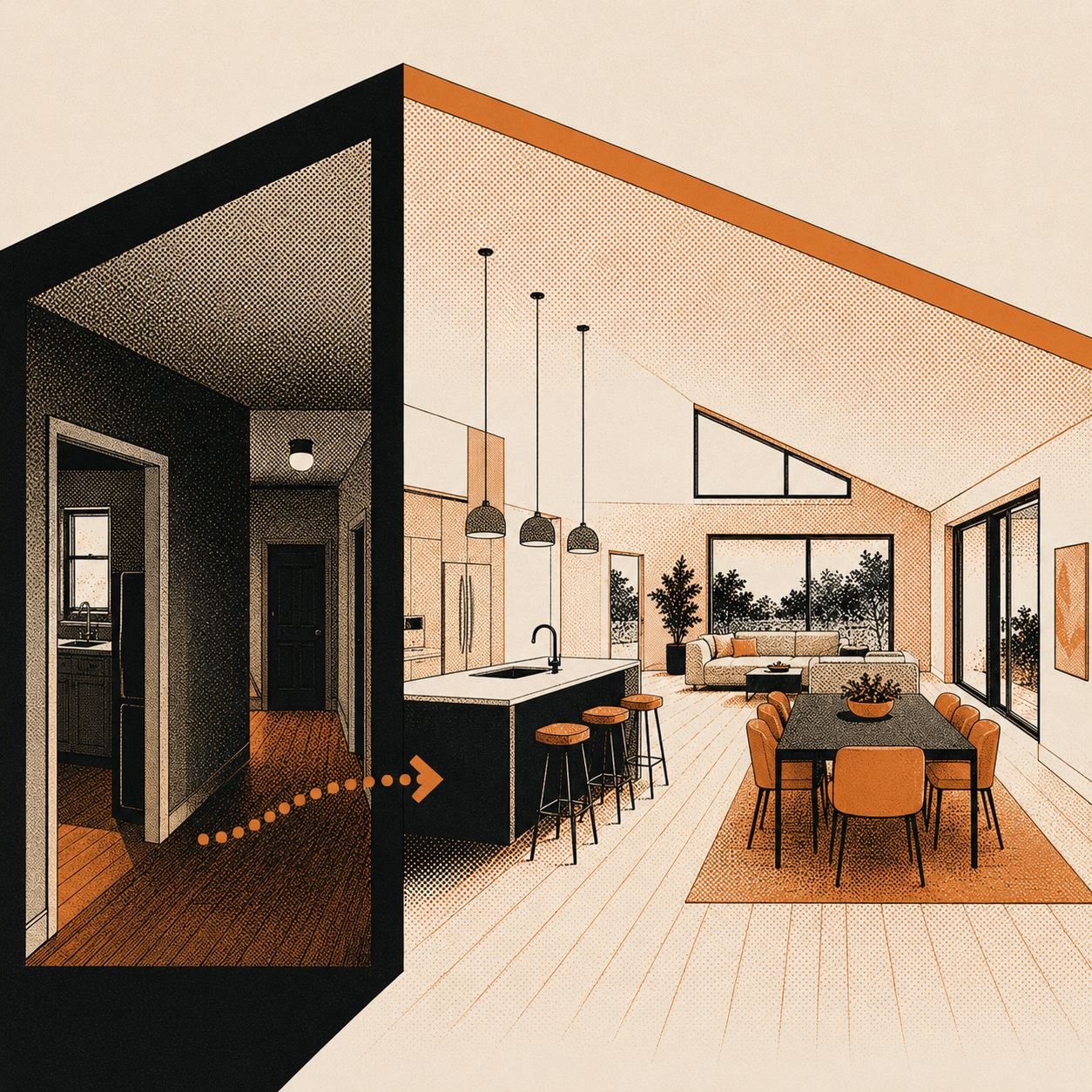
There's something deeply satisfying about taking a house that doesn't work and transforming it into something that fits your life perfectly.
You see the "before." You see the problems. You see the frustration the homeowners have been living with for years—the cramped kitchen, the awkward layout, the lack of light, the wasted space.
And then you solve it.
You rethink the flow. You open up a wall. You bring in natural light. You reconfigure the spaces so they finally make sense.
And when it's done, the homeowners feel like they're living in a completely new house.
That transformation—that shift from "this doesn't work" to "this is exactly what I needed"—is incredibly rewarding.
And honestly? There are so many homes out there that need exactly this kind of attention. Homes that are structurally sound, in great neighborhoods, with good bones—but layouts that don't work for modern life.
If I can help fix those homes, one at a time, that feels meaningful.
Why Remodeling Is More Sustainable Than Building New
Let's talk about waste for a second.
New construction is incredibly wasteful. Massive amounts of material get thrown away on every project. Lumber, drywall, insulation, packaging, metal, concrete—it all ends up in a landfill.
Remodeling isn't waste-free, but it's significantly better.
When you remodel, you're working with what's already there. You're preserving the structure. You're keeping the foundation, the framing, the roof. You're not demolishing an entire house and starting from scratch.
Yes, you're going to demo some walls. Yes, you're going to replace some materials. But the overall material footprint is much smaller than tearing down and rebuilding.
And from a sustainability perspective, that matters.
I think as a profession—and as a society—we need to be more thoughtful about how we approach housing. We have a massive stock of existing homes. Many of them are perfectly salvageable. They just need to be updated to fit how we live today.
Instead of tearing them down and building McMansions in their place, why not transform them into something better?
You Don't Have to Move
Here's another reason I love remodels: you get to stay where you are.
A lot of people assume that if their house doesn't work, they need to move. They need to find a bigger house, a better layout, a newer build.
But moving is expensive. Moving is disruptive. And moving means leaving the neighborhood you love, the community you're part of, the location that works for your life.
What if instead of moving, you just fixed the house you're already in?
What if you could have the layout you want, the finishes you want, the flow you want—all in the house you already own, in the neighborhood you already love?
That's what remodeling makes possible.
And when clients finish a remodel and see the transformation, they're always thrilled. They feel like they have a completely new home—without the stress and cost of moving.
It's Not About the Size of the Project
Here's something else people get wrong: they think I only want to work on big, expensive projects.
That's not true.
Yes, bigger and more complex projects are more satisfying in some ways—there's more to solve, more creative challenges, more transformation.
But there's no minimum size for a remodel.
I've worked on projects where we didn't touch a huge amount of square footage, but the impact was massive. We made a few strategic moves—opened up a wall, reconfigured a bathroom, brought in more light—and the house felt completely different.
That's just as rewarding as a full-scale gut renovation.
What matters to me isn't the size or the budget. It's the quality of the work and the people I'm working with.
If it's going to be good quality work and you're good people, I'm in. Let's do it.
Remodels Are Harder—And That's Why They're Interesting
I said this earlier in the series, but it's worth repeating: remodels are harder than new construction.
New construction is a blank slate. You control everything from the start. You're not working around existing conditions. You're not dealing with surprises behind the walls.
Remodels are the opposite. You're working with constraints. You're problem-solving constantly. You're adapting on the fly.
And that makes them more challenging.
But it also makes them more interesting.
The constraints force me to think harder. They force me to be more creative. They force me to come up with solutions I wouldn't have thought of if I'd had total freedom.
And honestly? That's the kind of work I love.
The Three Takeaways
If you're thinking about remodeling—or if you've been on the fence about whether to remodel or move—here are the three things I want you to take away from this:
1. You probably don't need to move.
Your house can be transformed. You just need the right architect to help you see what's possible.
2. Flow matters more than finishes.
Fix the layout first. Worry about tile and paint colors later.
3. Remodeling is more sustainable, more personal, and more rewarding than building new.
You get to keep what's good about your house, fix what's broken, and end up with something that's uniquely yours.
Final Thought
There's a house out there—maybe it's the one you're living in right now—that has incredible potential.
It just needs someone to see it. Someone to understand what it's trying to be. Someone to solve the problems that have been holding it back.
That's what I do. And I love it.
So if you've been thinking about remodeling, or if you've been frustrated with your house and don't know what to do next, reach out.
Let's talk. Let's figure out what's possible.
You might be surprised by how much your house can change.